
Introduction
Aquatic therapy is a type of exercise that takes place in water. People have been using water for healing purposes for centuries due to its therapeutic properties. However, in the 20th century, aquatic therapy became more popular, especially for movement rehabilitation. The American Physical Therapy Association (APTA) recognized aquatic therapy as a legitimate form of physical therapy and rehabilitation in 1992 [1].
The effectiveness of aquatic therapy can be attributed to several fundamental principles that govern the behavior of water, including buoyancy, thermodynamics, hydrostatic pressure, density, and viscosity. These principles make water a safer and more efficient medium for rehabilitation. Aquatic training significantly reduces the impact forces experienced by bodily tissues during exercise, enabling increased amounts of training before reaching the injury threshold.
Aquatic exercises can significantly reduce peak impact forces (33% to 54%), impulse (19% to 54%), and rate of force development (33% to 62%) compared to land-based exercises. Numerous studies have highlighted the benefits of aquatic therapy in enhancing strength and power following injuries, as well as in sports performance [2-11].
Football is a high-impact contact sport that demands rigorous training regimens involving exercises characterized by substantial intensity and impact forces. The nature of the sport itself, which often includes dynamic movements, sudden changes in direction, and collisions, places football players at an inevitably higher risk of injury during their training sessions.
The training module for football players is designed to enhance all aspects of their physical fitness, which includes strength, speed, agility, and endurance. These exercises often involve dynamic movements, such as sprinting, jumping, and tackling, which impose great stress on the musculoskeletal system. This combination of high-intensity training drills and the repetitive nature of movements can cause overuse injuries that affect joints, muscles, and ligaments.
Aim of the work
The nature of football training demands high-intensity exercises and physical contact that heightens the risk of injuries for players. Therefore, it is of utmost importance to acknowledge these risks, and the implementation of comprehensive injury prevention measures is an integral aspect of ensuring the health and well-being of football athletes throughout their training regimens. This systematic review aims to examine studies conducted within the last decade to assess the effects of aquatic therapy exercise programs on key components of football players’ fitness, including speed, agility, and lower limb power.
Methods
This review study is performed following the PRISMA (Preferred Reporting Items for Systematic Reviews and Meta-Analyses) guidelines [12].
To conduct this review, comprehensive searches were carried out across multiple databases, namely PubMed, Google Scholar, and PEDro. The chosen keywords encompassed terms such as “aquatic therapy”, “sports players”, “football players”, “speed”, “agility”, “power”, “core strength”, and “kick velocity”. Boolean operators “AND” and “OR” were strategically employed to refine search queries, and the search scope was confined to articles published in English within the timeframe of 2012 to 2022. The screening process involved a meticulous examination of titles and abstracts for adherence to predetermined inclusion and exclusion criteria, followed by a thorough assessment of the full texts of potentially eligible articles by two independent reviewers.
Exclusion criteria
To evaluate the quality of selected articles, the researchers used the PEDro scale [13,14], which comprises 11 questions and evaluates internal validity and statistical information. Articles that scored ≥5 out of 10 were considered to be of high methodological quality. The studies were analyzed independently by two investigators using the PEDro scale.
Screening and data extraction were conducted independently by two investigators. Data included year of authorship, study subjects, age, interventions, study duration, outcome measures, and results. Discrepancies between investigators were resolved through discussion.
Literature review results
The inclusion and exclusion criteria led to the retrieval of articles from various databases: Google Scholar (1,440 articles), PubMed (69 articles), and PEDro (3 articles). Of these, 1,050 articles were repeated, therefore 460 abstracts were screened. Subsequently, 450 articles were excluded due to reasons such as unavailability in full text, lack of objectivity failure to meet inclusion criteria, or absence of a control group or non-aquatic therapy intervention. Finally, 10 articles were selected for quality assessment as seen in Figure 1.
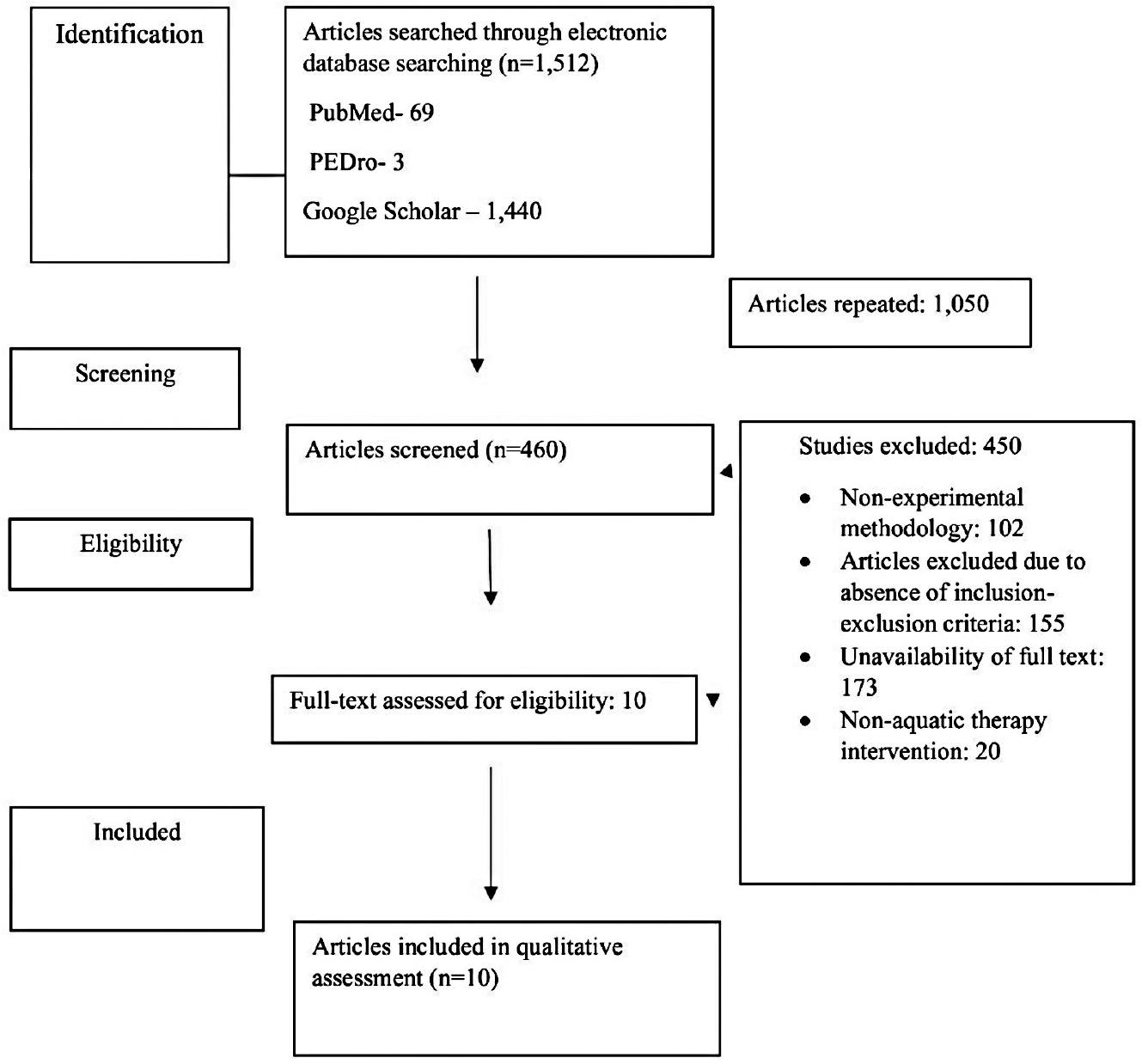
Quality assessment of the study
As shown below in Tables 1 and 2, seven selected articles scored 8/10 [2-4,6,9-11] one scored 7/10 [7], and one scored 6/10 [5] on the PEDro scale. The studies were found to be of high methodological quality when they scored ≥5. One article with a moderate risk of bias had unclear allocation concealment and failed to meet blinding criteria [5].
Table 1
Quality assessment of articles included in systematic review
Table 2
Risk of bias assessment table
General data of included studies
Table 3 gives a summary of all the articles included in this systematic review. The selected articles, published between 2012 and 2022, included male football players with ages ranging from 12 to 30. Total subjects (n) in the studies varied from 18 to 65. The intervention duration ranged from one-time studies to three months. The outcome measures included lower limb power, strength, endurance, speed, agility, and cardiovascular endurance.
Table 3
Summary of all articles included in the systematic review
Outcome measures
Speed was assessed using various sprint tests, agility using the Illinois agility and T-test, lower limb power through vertical jump tests, and cardiovascular endurance using a 12-minute running test and Burpee test for strength-endurance [2-6,9-11]. One of the articles assessed pain using the visual analogue scale (VAS), adductor strength by squeeze test, flexibility using the sit-and-reach test, and range of movement in the ankle and hip [7].
Discussion of the review results
This systematic review aimed to evaluate the effectiveness of aquatic therapy on football players’ performance. It included 10 articles, consisting of eight experimental studies and two Randomized Control Trials (RCTs), all rated high in methodological quality. The studies explored different aquatic training protocols and their effects on football players’ performance parameters, such as speed, agility, leg power, and endurance.
Three studies showed significant improvements in speed and agility following aquatic therapy [3-5,9,10], while five studies reported significant enhancements in leg power [2,4-7]. An RCT conducted as a one-time study concluded that aquatic exercises improve leg strength and flexibility compared to a control group undergoing contrast therapy with shallow water treadmill running [7]. Another RCT showed that six weeks of hydrotherapy significantly improved single-leg tests [11].
Various intervention protocols were employed across the studies, which included aqua aerobics, aqua plyometrics, and aquatic exercises, all of which resulted in performance measure improvements. The variability in sample sizes, ranging from 18 to 60 subjects, as well as the wide array of outcome measures, highlighted the diversity in study design.
Despite variations in methodology, most studies demonstrated significant improvements in football player performance parameters after aquatic therapy, reinforcing its effectiveness as an intervention protocol.
Conclusions
In summary, the examination of aquatic therapy exercises has demonstrated a notable improvement in leg power, speed, and agility among football players. Nevertheless, it is noteworthy to mention that the review of the literature did not identify any studies exploring the impact of aquatic therapy on core strength and kick velocity in football players. Kick velocity is an important component in football that influences the effectiveness of goal scoring, passes, and overall performance. The presence of a research gap in the relationship between kick velocity and aquatic therapy and core strength and aquatic therapy leaves scope for future research to explore its potential impact. Addressing these concerns will help to understand the benefits and applications of aquatic therapy in the field of football training.