
Introduction
Acne vulgaris ranks among the prevalent skin conditions in Europe and stands as the most widespread in the United States [1]. This condition impacts around 80% of teenagers and can persist as a notable issue into adulthood, especially among females. Nearly half of women suffer from acne onset after reaching 25 years of age [2]. Acne vulgaris is a persistent condition of the hair follicle and sebaceous gland complex, characterized by inflammation symptoms such as redness, edema, and discomfort, often accompanied by scarring [1]. Acne can cause significant anxiety, a reduced self-esteem, and a higher occurrence of depression and thoughts of suicide. In addition to diminishing quality of life, acne significantly contributes to the prolonged use of oral antibiotics among young people [3].
Aim of the work
The objective of the study was to describe the pathogenesis of acne and the influence of isotretinoin on its inhibition, as well as the benefits and adverse effects of this medication.
Methods
To compile this review paper, extensive searches were carried out across various databases such as PubMed and Google Scholar. The keywords encompassed “acne”, “acne vulgaris”, “isotretinoin”, “13-cisretinoic acid”, and “dermatology”. Articles considered were those published between 2017 and 2024. The initial phase of article selection involved assessing titles and abstracts to ensure they met the predefined criteria. This screening process aided in identifying articles pertinent to the paper’s theme. Subsequently, a comprehensive review of the complete texts of possibly relevant articles was conducted, allowing for the retrieval of the most pertinent data.
Literature review results
Development process of acne
Acne is primarily a disease of the of the hair follicle and sebaceous gland complex, resulting in both inflamed and non-inflamed lesions and in scarring, primarily impacting the face, occasionally also the trunk [3].
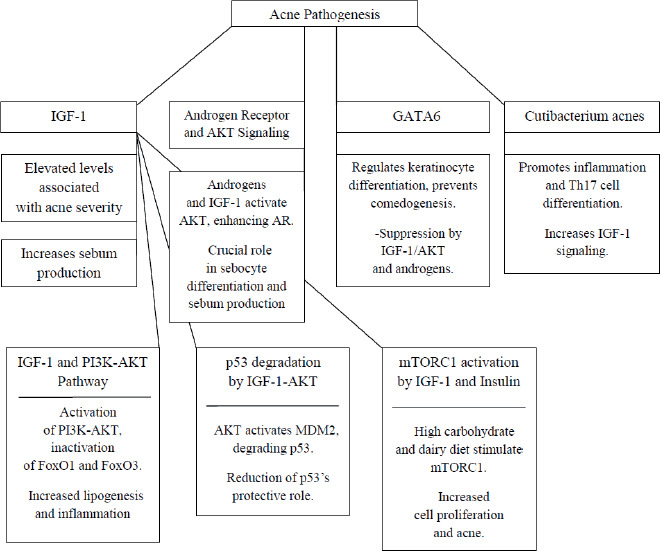
In the pathogenesis of acne, four factors are involved: excessive sebum production and abnormal sebum quality, changes in the way the hair follicle sheds cells, influences facilitated by Cutibacterium acnes, and inflammation [4,5]. Sebum overproduction results from an excess of androgenic hormones or heightened responsiveness of sebaceous glands to standard concentrations of androgenic hormones. Therefore, acne is more common in individuals with syndrome of polycystic ovaries, adrenal hyperplasia/ tumors, and conditions associated with hyperandrogenism. Acne might also be genetically influenced, though specific genes associated with risk have not been pinpointed [3,6]. The inflammatory state present in acne is primarily associated with alterations in the transcriptional regulation of pathways such as IGF-1/ insulin/PI3K/AKT/mTORC1 and androgen/AR/mTORC2/AKT signaling, which impair the nuclear activity of p53 (Figure 1) [4]. Certain food products and beverages, particularly food with a high glycemic index (sweetened beverages, foods rich in starch, heavily processed foods), as well as skimmed milk, appear to influence the exacerbation of acne [6]. Some medications can exacerbate acne, primarily progestin-only contraceptives, but also glucocorticosteroids, androgens, certain antiepileptic drugs, and lithium [3].
Classification and diagnosis
Acne is diagnosed through a combination of patient history and physical examination. Lesions may present as non-inflammatory, closed comedones (papules formed due to the buildup of sebum and keratin within the hair follicle); open comedones (enlargement of hair follicles due to keratinization, resulting in the opening of follicles, lipid oxidation, and melanin buildup); or inflamed papules, nodules, pustules, cysts [3]. Additionally, patients with acne may exhibit other symptoms such as scarring, erythema, and hyperpigmentation [7]. Inflammatory changes occur as a result of the rupture of the follicle, initiating an inflammatory response. Depending on the number and type of lesions, acne intensity can be categorized as mild, moderate, or severe [3,6]. There is insufficient proof to support distinct treatments for various subtypes of acne. The National Institute for Health and Care Excellence (NICE) guidelines, along with most other recommendations, offer varying guidance depending on the intensity of acne rather than its subtypes [8]. In the differential diagnosis of acne vulgaris, one should consider acne cosmetica, acne caused by medication, folliculitis, heat rash, shaving bumps, rosacea, and dandruff [6].
Indications for the use of oral isotretinoin
In the treatment of mild to moderate acne, topical adapalene, benzoyl peroxide, tretinoin, clindamycin, azelaic acid, or oral antibiotics are used. The primary choice of oral antibiotics includes lymecycline and doxycycline. If these are not well-tolerated, guidelines recommend consideration of trimethoprim or an oral macrolide [8]. According to the NICE guidelines, isotretinoin treatment should be contemplated in people over 12 years of age who suffer from severe acne unresponsive to standard courses of oral antibiotics and topical therapies [6]. Indications for the use of oral isotretinoin include:
Isotretinoin action and dosage
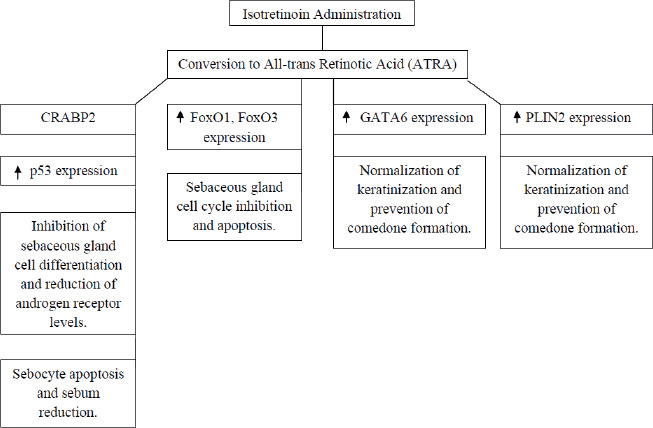
Isotretinoin is an initial retinoid authorized by the Food and Drug Administration (FDA) in 1982 [9]. It is approved for the treatment of severe, refractory nodular acne that does not respond to conventional treatments, including systemic antibiotics. Although the precise mechanism of action remains unclear, isotretinoin at pharmacological doses suppresses sebaceous gland activity and keratinization. The medication has been noted to decrease both the size of the sebaceous glands and the generation of serum [7,10]. There are studies showing that oral isotretinoin increases the presence of p53 in the cell nucleus of the sebaceous glands and skin of individuals with acne (Figure 2) [11]. Treatment starts with a dose of 0.5 mg/kg/day, which can be increased to 1.0 mg/kg/day after tolerance. To reduce the risk of disease recurrence, a total dose of 120-150 mg/kg is used, and the duration of treatment is usually 5-8 months [12].
Side effects
Side effects can be divided into: 1) teratogenic, 2) clinical: pertaining to the skin or beyond the skin, and 3) laboratory test results. Additionally, oral isotretinoin has been linked with non-specific side effects affecting different bodily systems, though typically as occasional and separate cases [1].
Isotretinoin and its byproducts influence a considerable array of human cell types, affecting them positively and negatively. Their influence on keratinocytes results in negative effects on mucous membranes and skin, affecting hair follicle cells and leading to the onset of telogen effluvium, on myocytes – emission of creatine phosphokinase, liver cells – elevation in homocysteine concentrations, neural crest cells – teratogenicity, or hippocampal cells, which may be associated with decreased hippocampal neurogenesis and depression [13].
Teratogenicity
Oral administration of isotretinoin by women of reproductive age, regardless of the dose, may in a large percentage of cases cause serious fetal malformations, premature birth, or spontaneous miscarriage. Various forms of pregnancy prevention programs have generally been somewhat effective, as unplanned pregnancies still occur during treatment with isotretinoin, though in limited numbers [10].
These protocols mandate that women capable of childbearing utilize two efficient forms of contraception or remain completely abstinent during isotretinoin treatment. Patients are subjected to pregnancy tests: prior to initiating therapy, monthly at the onset of each menstrual cycle throughout treatment, and one month following treatment cessation [1,10].
Cutaneous side effects
Common and less serious side effects associated with oral isotretinoin include mucosal and skin disorders, caused mainly by the reduction in sebum production and the detachment of skin cells, leading to dry and flaky alterations [1]. Dry skin, skin fragility, erythematous changes, and itching or rash are the most frequently observed side effects in the meta-analysis performed by Kapała et al. [14].
Telogen effluvium is induced by 13-cis-retinoic acid, which sometimes results in accidental androgenic alopecia, and hair loss might persist. Alopecia caused by isotretinoin is believed to be the least prevalent in comparison to other retinoids. The research examined in the meta-analysis conducted by Kapała et al. did not assess the reversal of pathological changes after treatment, but if the hair loss was due to telogen effluvium, it likely resolved after treatment [14].
The study conducted by Kaya İslamoğlu et al. also confirmed that synthetic vitamin A does not change short-term hair growth parameters and without using extremely high doses [15].
Tran et al. [16] in a retrospective review study showed that of 6,330 people taking isotretinoin between 2013 and 2018, 19 people experienced hair loss simultaneously or within two years after taking isotretinoin. Therefore, it is important to remember that patients experiencing hair loss should be informed about this possible side effect [16].
One of the possible, albeit rare, complications following the use of oral isotretinoin is the development of acne fulminans. Acne fulminans is a rare disease of unknown etiology, occurring almost exclusively in Caucasian adolescent boys with a history of papulopustular acne. It is characterized by a sudden onset and a rapid, aggressive course [17]. Fakih et al. presented a case of a young boy who developed acne fulminans after isotretinoin therapy at a dose of 0.1 mg/kg/day [18].
Vision disorders
Vision disorders such as blurred vision, deterioration of vision after dark, dry conjunctiva, or eyelid itching are the most common ophthalmological effects. Their cause may probably be atrophy of the lacrimal and meibomian glands [19]. Zakrzewska et al. [20] confirmed that isotretinoin therapy leads to the intensification of eye problems caused mainly by dysfunction of the lipid component of the tear film. These were reversible changes in the functioning and morphology of the meibomian glands observed during treatment, but after the end of therapy, the results improved [20].
Adverse effects such as dry eye syndrome and visual disturbances can be minimized by better educating patients about potential ophthalmological symptoms during tretinoin use. A study in Saudi Arabia by AlMasoudi et al. [21] revealed that almost 60% of patients did not know about potential contact lens discomfort during isotretinoin treatment, and merely 67.5% received prescriptions for lubricating eye drops. Additionally, only 67.9% of patients were informed about the ophthalmological adverse effects of this drug [21].
Headaches
Headaches are usually sporadic with minor side effects and disappear quickly after discontinuation of treatment. However, they should not be ignored as they may be a symptom of other, more serious diseases, e.g., diseases of the central nervous system [14].
Nasal mucosa
Other side effects of therapy may include disorders of the nasal mucosa. Tasli et al. [22] based their study on the evaluation of subjective tests (NOSE questionnaires) and objective tests (rhinomanometry and saccharin level) to assess the intensity of nasal symptoms. Oral isotretinoin therapy has been shown to cause nasal congestion, dryness/crusts, and epistaxis during treatment [22].
Psychiatric disorders and suicide attempts
Studies on the impact of oral isotretinoin on patients’ psychiatric conditions are ongoing [9]. Algamdi et al. [23] studied 18 patients who had never used isotretinoin and did not have a personal or family history of mental illness. The study found that after 8 weeks of treatment with isotretinoin at a dose of 0.5 mg/kg, there was no increased risk of depression. The findings did not show a direct link between isotretinoin use and depression. Additionally, effectively managing and treating acne vulgaris has been demonstrated to enhance depression outcomes [23].
AlGhofaili et al. [24] reached similar conclusions in a study involving 179 patients, where depression symptoms were evaluated using the Beck Depression Inventory. The research found that treating acne with isotretinoin did not significantly increase the risk of depression in the Saudi Arabian population [24].
Regulatory authorities continue to discuss and examine the risk of suicide linked to isotretinoin usage. Droitcourt et al. [25] evaluated the likelihood of suicide attempts prior to, during, and following isotretinoin therapy. By employing Nationwide French Health Insurance data spanning from 2009 to 2016, researchers conducted a cohort and nested case-time-control study involving individuals up to 50 years of age who were treated with isotretinoin. The incidence of attempted suicide during isotretinoin therapy was significantly lower compared to the general population of France. Patients taking isotretinoin had a reduced risk of attempting suicide, and there was no evidence that starting isotretinoin triggered suicide attempts [25].
Some researchers also tried to check whether isotretinoin treatment increases the level of anger in patients. The study by Yancar Demir et al. [26] elucidates dimensions of anger including thoughts, behaviors, and reactions associated with anger in people undergoing retinol treatment for acne vulgaris. This correlation, however, has not been reported in other studies [26].
Musculoskeletal system
Side effects on the musculoskeletal system include musculoskeletal pain and joint pain (arthralgia). Rarer side effects are hyperostosis, calcifications outside the vertebrae, inflammation of the entheses, joint inflammation, osteochondritis, osteoporosis, stunted growth, and early closure of bone epiphyses in children. These symptoms may result from changes in the structure of lysosomal membranes, degeneration of synovial cells, and/or increased matrix metalloproteinase type 2 (MMP-2) activity, which damages joint membranes [14].
Mülkoğlu et al. [27] examined the influence of oral isotretinoin treatment on muscle strength and examined the association between creatine phosphokinase (CPK) levels and strength of the muscles. The strength of the hamstring tendon and quadriceps muscle on the weaker side were tested on 60 patients. The authors concluded that oral isotretinoin does not affect muscle strength and that there is no correlation between CPK levels and muscle strength [27].
Özkoca et al. [28] examined the frequency of tiredness, muscle pain, and lumbar pain during systemic isotretinoin therapy. Tiredness was experienced by 4.4% of patients, muscle pain by 2.8%, and lumbar pain by 25%. Among these, 2.2% experienced inflammation, and 22.8% experienced mechanical back pain. These adverse events were found to be regardless of age or gender, dosage of medication, therapy duration, and prior medication use. The authors concluded that musculoskeletal side effects are relatively uncommon and should not limit the prescription of isotretinoin for treating acne vulgaris [28].
Laboratory test results
Isotretinoin therapy elevates liver function parameters and lipid profiles. In nearly all cases, these abnormalities resolve immediately after the therapy is completed [14].
Alajaji et al. [29] studied the incidence of abnormal laboratory results for triglyceride, cholesterol and liver transaminases levels among acne individuals undergoing oral isotretinoin treatment. The results of this research suggest that systemic isotretinoin could lead to elevations in alanine aminotransferase, aspartate aminotransferase, total cholesterol, and triglyceride levels, although the occurrence of these abnormalities is infrequent. Individuals with greater body weight face an increased risk of experiencing irregularities in laboratory tests and may necessitate increased surveillance of these tests [29,30].
Although infrequent occurrences of abnormal test results often have no significant impact on treatment decisions, the common practice remains frequent monitoring of laboratory tests. Enhancing patient care quality for those undergoing isotretinoin treatment for acne involves decreasing the frequency of monitoring lipids, aminotransferases levels and discontinuing complete blood count monitoring if deemed unnecessary [31].
Conclusions
Acne vulgaris is a chronic inflammatory disease of hair follicle and sebaceous gland complex occurring in the form of open/closed comedones, inflammatory papules, pustules, and/or cysts that might lead to scarring. Isotretinoin, a synthetic form of vitamin A used in patients with nodular and resistant acne that is not amenable to conventional treatment.
It is a systemic medicament that affects not only keratinocytes and sebaceous cells but also other cells of our body. Therefore, side effects include skin changes, visual disturbances, neurological changes, and abnormalities in laboratory tests. However, most of these side effects depend on the dosage and length of the treatment and disappear after the end of treatment. It is important to inform the patient about side effects and how to prevent them or reduce their severity. The doctor’s duties also include regular monitoring of liver parameters, lipid profile, and blood count.