
Introduction
Individuals who have reached the age of 65 are the fastest-growing age group. Low-energy fractures, including those of the proximal end of the femur, which include femoral neck fractures, are one of the most common bone injuries in the population. They are associated with a relatively high degree of mortality [1-3]. It ranges from 10% in the first month after injury regardless of the treatment method, and after a year it increases to 20-52% [4,5], and is higher in the male group than in the female group [6,7], although this type of fracture occurs more frequently in women [8]. Among the predisposing factors, there are, among others: increasing age, female gender, and the occurrence of osteoporotic fractures in the family, while non-modifiable factors include: low body mass, i.e., BMI below 18.5, low physical activity, substance abuse (alcohol, tobacco), and malnutrition. It should be remembered that with age, there is also a weakening of muscle strength, vision, and motor coordination, increasing the risk of falls from one’s own height, which can result in low-energy fractures [9].
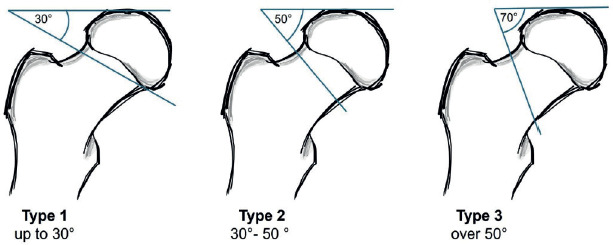
Garden’s classification includes 4 degrees and takes into account the type of damage and displacement of fragments. The first degree means no displacement, the second can also be non-displaced or displacement is very slight, resulting from complete cortical layer damage, distinguishing the first degree from the second. The third degree involves partial displacement, while the fourth involves complete displacement [10]. Pauwels’ classification, on the other hand, is based on the angle of inclination of the fracture plane to the horizontal level.
Three types are distinguished here. In the first type, the inclination of the fracture gap to the horizontal level is within the range of 0-30 degrees (Figure 1). This type of fracture occurs when compressive forces prevail over shearing forces. The risk of non-union and avascular necrosis of the femoral head is minimal. The second degree is characterized by a fracture gap at the level of 30-50 degrees, and compressive and shearing forces are present at the fracture base, with none dominating. The risk of complications is higher than in the first case. The third type is characterized by a fracture gap greater than 50-70 degrees. The fracture occurs when shearing forces dominate over compressive forces, which creates significantly the worst conditions for union, increasing the risk of complications. In both classifications, an increase in the degree correlates with a worse prognosis [11,12].
Based on the data and the patient’s clinical condition, the choice of treatment is made. The aim of treatment is to let the patient regain hip joint function as quickly as possible and verticalize the patient, reducing the risk of health and life-threatening complications. The preferred method is surgery, which can be used to apply: treatment using internal stabilization in young patients with fractures classified as Grades I and II in both Garden’s and Pauwels’ classifications. Grades III and IV according to Garden and Grade III according to Pauwels use endoprosthetics, as there is no risk of avascular necrosis of the femoral head as a complication after surgery. Partial endoprostheses can be used in younger individuals, while total endoprostheses can be used in older individuals [13].
Non-operative treatment is practiced only in individuals with absolute contraindications to surgery. For the patients, early verticalization is recommended to avoid both medical and orthopedic complications [14,15].
The analysis of mortality rates in femoral neck fractures is critical for evaluating treatment efficacy and prognostic factors. Despite periodic variability, mortality rates remain generally stable over time. Studies report comparable outcomes across observation periods, with rates of 8.83%, 20.14%, 36.75%, and 45.22% at 1, 4, 12, and 24 months in one group, and 8.86%, 23.15%, 32.51%, and 33.49% in another, underscoring their consistency despite varying conditions [16].
Aim of the work
The aim of the study was to perform a retrospective, epidemiological assessment and compare the clinical and radiographic outcomes of patients with femoral neck fractures treated at the Department of Orthopedics and Traumatology. A key point highlighted in this study is the need for more frequent consideration of the Garden’s and Pauwels’ classifications, as well as patient age criteria, in treatment selection – an approach that could significantly reduce actual mortality rates. Through the delineation of a comprehensive patient profile, the findings are expected to enable more individualized inpatient management, thereby improving patient satisfaction and expediting postoperative restoration of mobility.
Material and methods
The research material comprised 157 patients treated between 2021 and 2023 due to femoral neck fractures at the Department of Orthopedics and Traumatology.
Inclusion criteria encompassed patients with femoral neck fractures regardless of age, provided that complete medical documentation was available. The approach ensured a broad dataset, allowing for the identification of trends and correlations within a diverse patient population. Exclusion criteria included patients lacking key medical data, such as Pauwels’ angle measurements or assignment of a grade in the Garden’s classification, primarily due to the unavailability of X-ray images in the documentation system, often resulting from the transfer of patients from lower-referral centers. The analysis included the average age of men and women, time from injury to surgery, side of the fracture, methods of fracture treatment, type of fracture (high-energy/low-energy), and the degree in the Pauwels’ and Garden’ classifications. The Pauwels angle was measured by one person three times, and then the average of the measurements was calculated. The degree in the Garden’s classification was set by the same person. The number of patients included in the analysis, with a consideration of the patients’ gender, is presented in Table 1. In the analyzed material, a significant predominance of women was observed, accounting for 72% of all patients diagnosed with a femoral neck fracture.
Table 1
Number of treated patients due to femoral neck fracture, with a consideration of patients’ gender
| Gender | Number of patients | % of cases |
|---|---|---|
| Female | 113 | 71.98 |
| Male | 44 | 28.03 |
| Total | 157 | 100 |
The statistical analysis was conducted using Microsoft Excel, employing the formula for Student’s t-distribution to assess the significance of the observed differences.
Results
The youngest treated patient was 33 years old, while the oldest was 98 years old. The age distribution among women and men was similar. Table 2 provides the mean age, median age, and standard deviation of the treated patient group.
Table 2
Mean age, median age, and standard deviation of the treated patients’ age
| Number of cases | 157 |
|---|---|
| Average age | 78.78 |
| Median age | 81.00 |
| Standard deviation of age | 12.54 |
Table 3 presents the location of fractures divided into the right and left lower limbs.
Table 3
Fractures depending on the side of the body
| Lower limb | Number of cases | % of cases |
|---|---|---|
| Right | 78 | 49.68 |
| Left | 79 | 50.32 |
Analyzing the type of injury causing the fracture, it was observed that the vast majority of them were low-energy traumas (over 96% of cases). The data is presented in Table 4.
Table 4
Division of fractures based on the energy of the injury
| Type of injury | Number of cases | % of cases |
|---|---|---|
| Low-energy | 152 | 96.82 |
| High-energy | 3 | 1.91 |
| Others/no information | 2 | 1.27 |
All patients were classified according to the Pauwels’ and Garden’s scales. The compiled data is presented in Table 5 and Table 6.
Table 5
Number of patients with the adequate degree in the Pauwels’ scale
| Pauwels’ classification | Number of cases | % of cases |
|---|---|---|
| 1 | 8 | 5.1 |
| 2 | 47 | 29.94 |
| 3 | 102 | 64.97 |
Table 6
Number of patients with the adequate degree in the Garden’s scale
| Garden’s classification | Number of cases | % of cases |
|---|---|---|
| 1 | 2 | 1.27 |
| 2 | 49 | 31.21 |
| 3 | 105 | 66.88 |
| 4 | 1 | 0.64 |
Moreover, a positive correlation was observed between gender and age with the degree in the Pauwels’ classification as well as between age and the degree in the Garden’s scale (Table 7). Both the correlation between age and the Pauwels’ scale score, as well as the Garden’s scale score, were found to be statistically significant (p<0.001). However, no statistical significance was found in relation to gender.
Table 7
Correlation between gender and age with the degree in the Pauwels’ classification as well as between age and the degree in the Garden’s scale
| Independent variable | Dependent variable | Pearson correlation coefficient | Statistical significance |
|---|---|---|---|
| Gender | Pauwels | 0.03 | p=0.69 |
| Age | Pauwels | 0.33 | p<0.001 |
| Gender | Garden | -0.07 | p=0.37 |
| Age | Garden | 0.27 | p<0.001 |
Out of 157 patients, 140 individuals (over 89% of the total) underwent surgical treatment, while 17 were disqualified from surgical treatment due to the existing internist contraindications and were treated with non-invasive methods. During the treatment, an attempt was made to verticalize patients. The average age of non-surgically treated patients was higher than the age of surgically treated patients. Table 8 presents the number of patients treated with surgical and non-surgical methods (disqualified), diagnosed with a fractured neck of femur.
Table 8
Number of patients treated with surgical and non-surgical methods
During surgical treatment, three general methods of fracture management were used: total hip arthroplasty, partial hip arthroplasty, and internal fixation (e.g., neck screws, gamma nail fixation). The methods of surgical treatment for fractures of the femoral neck in the analyzed group of patients are presented in Table 9.
Table 9
Methods of surgical treatment used
| Methods of surgical treatment | Number of patients | % of operated patients |
|---|---|---|
| Internal fixation | 11 | 7.86 |
| Hemiarthroplasty | 82 | 58.57 |
| Total hip arthroplasty | 47 | 33.57 |
Patients most commonly received partial hip arthroplasty (in 58.57% of all patients treated surgically), while total hip prostheses were implanted in 47 patients. Internal fixation was used in the remaining 11 patients.
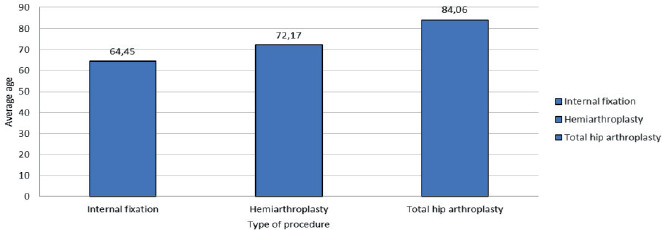
Analyzing the type of surgical treatment according to age, it was observed that the youngest age group consisted of patients who underwent internal fixation treatment. The average age of patients who received total hip prostheses was 72 years, while partial hip prostheses were implanted in patients with an average age of 84 years. The type of method according to the average age of patients is presented in Figure 2.
Discussion
The study found that femoral neck fractures predominantly affect women (72%), mostly due to low-energy trauma (96%). Pauwels type III (65%) and Garden type III (67%) were the most common classifications, with age significantly correlating to fracture severity (p<0.001). Most patients (89%) underwent surgical treatment, primarily partial hip arthroplasty, while younger patients received internal fixation. The results align with existing literature, emphasizing the role of age and fracture classification in guiding treatment strategies.
The issue of femoral neck fractures is gaining attention due to the increasing average lifespan and primarily affects the elderly population. It is noteworthy that femoral neck fracture is the most common cause of hospitalization resulting from hip or thigh trauma [17,18], with up to 2 million cases observed worldwide annually [19]. The expanding therapeutic options offer a chance for faster recovery of patients, but numerous burdens arising from advanced age, prevalent among those requiring surgical intervention, make their convalescence still difficult and costly. Majority of patients after femoral neck fracture treatment rate their quality of life as poor or very poor [20]. An analysis of the available literature reveals that total hip arthroplasty (THA) for the treatment of acute femoral neck fractures in elderly patients yields outcomes comparable to those observed in patients undergoing THA for osteoarthritis [21]. A range of complications during the treatment of the fractures necessitates collaboration among specialists in orthopedics, geriatrics, and internal medicine to minimize the effects of both the injury and prolonged immobilization.
In the study, an analysis of 157 femoral neck fractures was conducted. A significant majority (71.97% of cases) were women, consistent with literature data indicating a higher frequency of such fractures in the gender [8,18,20,22,23]. It could be attributed to both the increased risk of low-energy fractures due to decreased bone mineral density in women, as compared to men [24,25], as well as the longer average lifespan of women. Advanced age is a predisposing factor for the types of injuries [26], as confirmed by the mean age of treated patients [27] (Table 2). Femoral neck fractures occur more frequently in the winter season [8,28].
Fractures in patients occurred with nearly equal frequency on the right (49.68% of cases) and left (50.32% of cases) sides (Table 3), consistent with findings by other authors. Sundkvist et al. observed right-sided fractures in 48% of cases and left-sided fractures in 52% [23].
The dominant type of fracture among patients was low-energy fracture (96.18% of cases) (Table 4), consistent with data presented in the literature [8,29]. Bäcker et al. demonstrated that lateral femoral neck fractures occur in younger individuals (68.6±12.5 years), as compared to medial femoral neck fractures (76.0±13 years) [18].
Patients were assigned to the Garden’s and Pauwels’ classifications. The Garden’s classification, indicating the degree of displacement of bone fragments and the type of damage, is widely used to assess the risk of avascular necrosis of the femoral head. Among the treated patients, type III clearly predominated (66.88% of cases) (Table 6), necessitating the selection of optimal therapy to prevent complications. It is consistent with the findings of Sundkvist et al., who identified types III and IV in the Garden’s classification as the most common (63.4%) [23]. Similarly, the study by Galliker et al. reported more frequent fractures at levels 3 and 4 in the Garden’s scale [24]. Moreover, advanced age in patients, predisposing to atherosclerotic changes in peripheral vessels, is a risk factor for maintaining proper blood flow in vessels supplying the femoral head [30], further delaying patients’ return to independence. Among the patients studied, type III fractures predominated, accounting for nearly 65% of cases (Table 5).
A positive correlation was observed between gender and age, and the degree in the Pauwels’ classification, as well as between age and the degree in the Garden’s scale (Table 7), indicating that in older patients, fractures classified as high-risk, with poorer prognoses, are more prevalent. Bäcker et al. demonstrated a significantly lower mean Garden score for women at 2.6±1.0, as compared to 0.1±0.9 for men [18]. Our study did not show such a relationship. Additional burdens resulting from age, comorbidities, and in many cases, poor economic conditions exacerbate the difficulty in achieving therapeutic goals among patients in the age group.
Vast majority of the patients were treated surgically (89.17% of cases), with a mean age of 78.53 years (Table 8). The mean age of non-operatively treated patients was slightly higher at 80.88 years. Numerous contraindications to surgery, including advanced diabetes, severe anemia, or renal failure, in many cases result in disqualification of patients from surgical treatment and necessitate treatment with non-operative methods. Surgically treated patients mainly underwent hemiarthroplasty of the hip joint. The method is primarily used in older patients, as confirmed by the mean age of patients operated using the procedure (84 years), as compared to patients with total hip arthroplasty (72 years) (Figure 2), as supported by the literature [31]. Sundkvist et al. also showed that the majority of patients who reached 60 years of age and had a Garden score of 3/4 points underwent endoprosthesis surgery (89.4%) [8]. As previously described, majority of patients underwent surgical treatment, with partial hip arthroplasty being the most common method, while internal fixation was primarily performed on younger patients, but the choice of fixation method can vary depending on the biomechanical properties of the implants, application time, radiation exposure, fracture stability, and their impact on healing and function [32].
Patients treated with internal fixation belonged to the youngest age group. Similar results were presented by Sundkvist et al. Patients younger than 60 years were most often treated with internal fixation of the femoral neck fracture (74.3%) [8]. The method is used in younger individuals, where, due to the preservation of proper vascularization, the risk of avascular necrosis of the femoral head is small, and the chances of proper healing of the fractured limb are high [33].
Limitations
There are some limitations of the study. As a single-center, retrospective analysis, its findings may not be generalizable and are subject to data variability. The broad age range of patients may affect result homogeneity, and the lack of long-term functional outcomes or detailed comorbidity data limits the analysis. Future multicenter, prospective studies could address the issues. Moreover, as a result of the COVID-19 pandemic, there was a decrease in admissions due to femoral neck fractures and restrictions in the functioning of the Department of Orthopedics and Traumatology.
Conclusions
The study demonstrated a statistically significant correlation between the patient age and the severity of femoral neck fractures in both Pauwels’ and Garden’s classifications, confirming that older patients are more likely to sustain fractures with worse prognoses.
Surgical treatment, particularly partial hip arthroplasty, was the most commonly employed method, reflecting its suitability for the predominantly elderly patient group. Younger patients were primarily treated with internal fixation, aligning with best practices due to their higher likelihood of successful bone healing.
The findings highlight the importance of individualized treatment strategies based on age and fracture classification. Optimized approaches can enhance the efficiency of care, reduce complications, and improve clinical outcomes.
A better understanding of the epidemiology of femoral neck fractures, including risk factors like low-energy trauma and advanced age, can guide preventative measures and therapeutic decisions.
The study supports the need for collaboration among orthopedic, geriatric, and internal medicine specialists to address the multifaceted challenges associated with treating femoral neck fractures in elderly patients.