
Introduction
One of the most serious public health problems in Poland and worldwide is the incidence of and deaths from malignant neoplasms [1].
Prostate cancer (PCa), is the second most common cancer and the fifth most common cause of cancer deaths among men in 2020. It is the most commonly diagnosed cancer in men in more than half (112 out of 185) of the world’s countries. Incidence rates range from 6.3 to 83.4 per 100,000 men by region, with the highest rates in Northern and Western Europe, the Caribbean, Australia/New Zealand, North America and South Africa, and the lowest rates in Asia and North Africa. Prostate cancer is the leading cause of cancer deaths among men in 48 countries, including many countries in Africa, the Caribbean and Central and South America, as well as Sweden [2].
In Poland, PCa is one of the most common cancers in men at 19.6%, and the risk of developing the disease increases with increasing life expectancy. According to the Polish National Cancer Registry, there were 17,832 new PCa cases and 5,458 deaths in Poland in 2021. As the data show, the Masovian Province was ranked second in terms of incidence (1994) and first in terms of deaths (713) from PCa among men in Poland in 2021. The distribution of incidence and deaths by province is shown in Figure 1 [3]. As shown by the Masovian Cancer Registry (MRN), the Masovian Province ranked first in terms of the number of registered new cases of malignant neoplasms in general; the percentage was 12.2% of all malignant neoplasms, and first in terms of the number of deaths from malignant neoplasms; the percentage was 13.4% of all deaths from malignant neoplasms in Poland in 2021. However, among the total number of malignant neoplasms registered in 2021 in the Masovian Province, malignant neoplasms in men were the most common (prostate 20.0%, lung 16.1%, colon 6.6%, skin 6.4%, bladder 5.5%). The standardized incidence ratio was 39.8 new cases per 100,000 men for PCa. The distribution of morbidity and death by age in the province is shown in Table 1 [4].
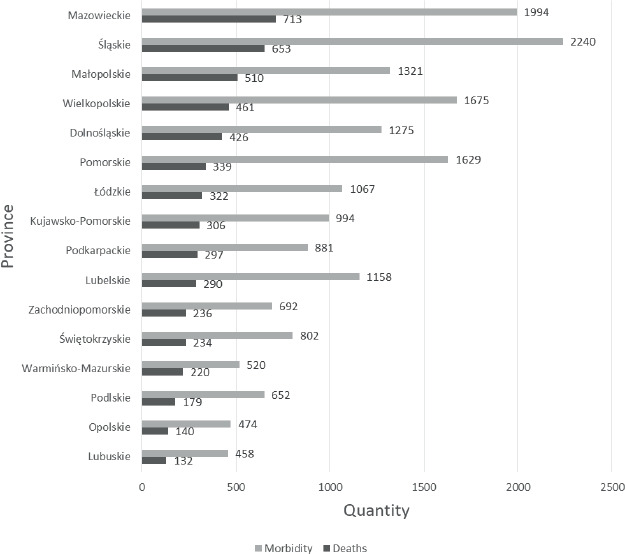
Table 1
Distribution of morbidity and deaths by age in the Masovian Province in 2021 [4]
Type | Age range | ||||||
|---|---|---|---|---|---|---|---|
| 0-39 | 40-49 | 50-59 | 60-69 | 70-79 | 80 + | Total | |
| Morbidity | 2 | 15 | 146 | 833 | 784 | 214 | 1994 |
| Deaths | 0 | 1 | 21 | 123 | 256 | 312 | 713 |
The main factor influencing the development of PCa is the ageing of the population. The majority of cases affect the male population over 60 years of age, with a peak incidence between 70 and 80 years of age. Cancerous lesions are rarely detected in men under 40 years of age [5-7].
The irreversible trend of an ageing population continues worldwide, so it is estimated that the incidence of prostate cancer among men will increase rapidly. The projections for an increase in the incidence of the disease are worrying, and it is therefore necessary to increase men’s health education activities [8].
One of the reasons for the late detection of PCa is men’s low awareness of the need for preventive screening. It is important that information on risk factors, symptoms, diagnosis and treatment of PCa is reliable and structured [6]. When taking preventive action with the male population, it is important to raise awareness of the importance of leading a healthy lifestyle. Dietary changes, prevention of obesity, reduction of animal fat intake, increased intake of plant products, especially soya and lycopene, products containing selenium, vitamin A, E and D, as well as increased physical activity and a hygienic lifestyle, significantly reduce the risk of the disease [1,6,9-11].
Secondary prevention, which aims to detect lesions at the earliest possible stage, as well as pre-cancerous conditions, is of primary importance in the control of PCa. Constant health monitoring enables early detection of dangerous changes and effective treatment [1]. For PCa, the recommended diagnostic tests used for screening are the serum Prostate Specific Antigen (PSA) test and a digital rectal examination. It is assumed that after the age of 40 the risk of prostate lesions increases [12] and this is confirmed by MRN data [4], therefore it is assumed that every man over the age of 50 should have his PSA antigen level determined once a year [13,14]. In addition to screening, it is very important to educate the patient about PCa, the causes and symptoms of the disease and the importance of follow-up examinations. Therefore, it is crucial to create awareness in men of all ages in promoting health and preventing many diseases. Of great importance in the prevention of PCa are the conditions in which the examination is carried out and the atmosphere surrounding the examination. Positive patient experience will result in increased regularity of testing [15-17].
In order to effectively reduce the number of deaths, it is necessary not only to look for new and more effective cancer treatments, but above all to develop reliable prevention programs. Raising awareness and knowledge of PCa will help prevent preventable deaths among men.
Research on the level of men’s knowledge of PCa and preventive activities in this area is important in terms of organized cancer prevention activities in Poland. The incidence projections are alarming and the predicted further increase in incidence requires greater emphasis on effective male education and prevention. This is the only pathway that can lead to improved cancer outcomes.
Aim of the work
The aim of this study was to assess men’s awareness of PCa and the subsequent occurrence of death as a result of late diagnosis and the role of preventive measures in the opinion of the men surveyed. Knowledge of risk factors and symptoms of the disease was analyzed in detail. In addition, knowledge of PCa prevention programs was assessed and factors influencing men’s level of participation in these programs were characterized.
Material and methods
Due to the fact that the Masovian Province occupied the first place in terms of the number of registered new incidences of malignant neoplasms in general; the percentage was 12.2% of all incidences of malignant neoplasms and the first place in terms of the number of deaths due to malignant neoplasms; the percentage was 13.4% of all deaths due to malignant neoplasms in Poland in 2021. The survey was conducted in health care facilities in the Wolomin district.
The research was conducted from February to June 2023. A proprietary survey questionnaire was used to collect the material, using the diagnostic survey method. The authors’ initial aim was to survey 150 men, but 106 correctly completed questionnaires were received. The study group consisted of men who met the following criteria: age 40 years or older (as screening guidelines suggest starting screening at this age), residence in the Wolomin District of the Masovian Province and consent to participate in the study.
A proprietary survey questionnaire was used as the tool. The general part of the questionnaire concerned the sociodemographic characteristics of the study group. The detailed part concerned knowledge of the types of preventive tests dedicated to PCa, the declared level of participation in these tests, an assessment of the accessibility of the tests, the obstacles present to taking the tests in the opinion of the respondents, and knowledge of risk factors, symptoms and openness to educational activities. The research was conducted in accordance with the principles of the Declaration of Helsinki [18] and was voluntary and anonymous. The respondents were informed about the purpose of the study and the possibility of resigning at any stage.
The results obtained were statistically analyzed using the χ2 test. A significance level of p<0.05 was adopted. In addition, the relationship strength (rp) was determined.
Results
In the study group, 31.13% (n=33) of the men were in the 60-69 age range, 26.42% (n=28) were aged 50-59 years, 25.47% (n=27) were aged 40-49 years and 16.98% (n=18) were aged over 70 years. The vast majority of people – 47.17% (n=50) had vocational education. Secondary education was held by 25.47% (n=27) of the men and higher education by 16.98% (n=18). Having primary education was declared by only 10.38% (n=11) of the respondents. More than half of the respondents were economically active men (53.77%; n=57), followed by retired persons/disability pensioners (46.23%; n=49).
Given the purpose of the study, it seemed appropriate to find out how men understood the role of preventive measures. Encouragingly, nearly 80% of the total number of men surveyed correctly identified disease prevention. For the vast majority (nearly 73%), PCa represented a serious, fatal disease.
Knowledge of PCa detection methods is crucial for prevention, as it allows men to undergo tests as recommended. Transrectal ultrasound of the prostate was known to nearly 50% of the respondents, about 46% had knowledge of the use of prostate-specific marker (PSA) level determination. The least known was the digital rectal (through the anus) examination. Only 28% of men were aware of such a test as a primary diagnostic procedure for PCa.
Of the social programs and campaigns in the field of PCa prevention, only the national educational program “I’ve got a hook for cancer” was known to the respondents, which was indicated by 10% of the men. Unfortunately, the vast majority (76%) were not aware of any of the prevention programs mentioned, only 4% of those surveyed had ever participated in them.
Knowing the symptoms of PCa is one of the basic pieces of information worth highlighting in educational activities. This makes it possible to detect the disease at the earliest possible stage of tumor progression, effectively improving treatment conditions and prognosis. The study found that nearly half of the men surveyed were familiar with the symptoms of PCa. As symptoms that may indicate a developing disease process, the respondents mainly indicated: frequent urination, especially at night (45%), intermittent urine stream (35%), low force with which the urine stream flows (34%) and longer time needed to start emptying the bladder (32%).
The incidence of PCa is influenced by a number of risk factors. The study identified an insufficient level of knowledge in this area among men. Most of them (75%) were not aware of the PCa inheritance problem. The respondents identified frequent inflammation of the urinary tract (42%), smoking (31%) and alcohol abuse (20%) as the most important risk factors. Only 14% of the respondents pointed to an inadequate diet, poor in fruit and vegetables, as one of the main factors preventing PCa.
The male respondents were asked about their sources of information on PCa. The largest group of the respondents mentioned family and friends (39%). The group of doctors and nurses who are expected to carry out educational activities was indicated by very few respondents (31% and 19% respectively). The smallest group mentioned meetings organized as part of PCa prevention (less than 1%), indicating the low effectiveness of the activities carried out.
Oncological vigilance for PCa consists of preventive examinations performed at the appropriate time in life. Of the men surveyed, only 40% indicated correctly – at 50 years of age – as the recommended time to start them. It was important to find out how men rated the accessibility to testing in their place of residence. Only a small group (15%) rated access as good enough.
The vast majority of men (89%) understand the importance of preventive examinations in terms of caring for their own health and being able to prevent prostate cancer. Despite this, as many as 60% of the respondents have not yet been tested for PCa. The main factor discouraging men from seeking preventive examinations appeared to be a perceived sense of embarrassment during the examination, as indicated by almost 50% of the respondents.
In the material discussed, men showed great interest in participating in educational activities on PCa (75% of the respondents), which indicates awareness of the insufficient level of knowledge in this area. From a public health perspective, it is important to address the problem of inadequate self-monitoring of men’s health. It is necessary to encourage participation in educational activities and, above all, access to preventive programs and knowledge about their implementation.
The relationships, their strength and statistical significance between the studied variables are presented in Table 2.
Table 2
Selected relationships between studied variables determining the level of men’s knowledge about prostate cancer and its conditions as well as the possibilities of preventive measures.
A statistically significant relationship of 0.001 (high relationship strength) was found between the respondents’ opinion of the disease and their age. Younger men were less likely to describe PCa as a fatal disease, while the older the age group, the more often this opinion was declared.
As expected, male participation in PCa prevention programmes and campaigns was negligible. The relationship between the respondents’ participation and age was found to be statistically significant at the level of 0.05 (average relationship strength). The older the age group, the greater the percentage of men who “never participated”.
The analysis showed that the respondents had a very low level of knowledge about the genetic background of PCa. It was observed that this was more often the case for people in older age groups. Statistically significant relationship at the level of 0.01 (average relationship strength).
A significant relationship between age and the assessment of accessibility to preventive examinations in the place of residence was confirmed at a significance level of 0.05 (average relationship strength). Men in older age groups assessed access to preventive tests poorly more often than in younger age groups.
A similar direction of relationship was observed between the level of participation in such programmes and education. The lower the level of education, the higher the percentage of “non-participants”. The observed relationship occurs at a significance level of 0.001 (high relationship strength).
A statistically significant relationship was also found between knowledge of the recommended age for PCa testing and education. The respondents with higher education were more likely to indicate the correct answer than the respondents with secondary and, in turn, primary education. Statistically significant relationship at the level of 0.001 (high relationship strength).
A significant relationship was also found between the education of the surveyed men and their opinion on factors discouraging the use of preventive PCa tests. As already mentioned, the most frequently indicated factor was the feeling of shame during the examination. The lower the level of education, the higher the percentage of the respondents giving this opinion. The observed relationship occurs at a significance level of 0.01 (average relationship strength).
The result of the chi-square test confirmed a significant relationship between education and opinion, on the role of preventive screening in the prevention of PCa (significance level of 0.001 – average relationship strength). The respondents with higher education were more likely to confirm the effectiveness of prevention measures than the respondents with secondary and successively primary education.
Discussion
The aim of the presented study was to determine the state of men’s knowledge of PCa and preventive measures in this area. Analyzing the available literature, it can be concluded that this is not a topic that is often addressed in studies. The validity of the adopted age limit for male participation in the study at 40 years and older is confirmed by other studies [19-23]. A study by Howlader et al. found that approximately 0.6% of PCa cases were diagnosed between 35 and 44 years of age; 9.7% between 45 and 54 years of age; 32.7% between 55 and 64 years of age; 36.3% between 65 and 74 years of age; 16.8% between 75 and 84 years of age; and 3.8% for 85 years and older [24].
In the conducted study, nearly 75% of men assessed their knowledge of PCa detection as insufficient and declared their willingness to improve it. The above finding correlates with the conclusions of the study by Deluga et al. where it was shown that, in the overall assessment of knowledge of PCa risk factors, an average level of knowledge was presented by 42.7% of the respondents, a high level of knowledge by 37.3% and a low level of knowledge by 20.0% [25].
Studies show that PSA screening reduces mortality in PCa [13,26-27]. The men surveyed were aware of how serious and deadly a disease PCa is. Despite this knowledge, nearly 60% of the men taking part in the survey had never had a PCa prevention test. In a study by Sosnowski et al. almost 30% of men did not perceive periodic prostate examinations as preventing complications and enabling early implementation of appropriate treatment [28]. In contrast, a study by Morlando et al. found that only 29.6% of men had undergone PSA testing and 59.4% were willing to do so in the future [29]. The proportion of the participants in a study conducted in Portugal who had undergone PCa screening at least once in their lifetime was 44.2% [30].
The literature shows that pain is the most common symptom reported by male PCa patients [31,32]. The study by Ngowi et al. [33] reports that men have low knowledge of PCa, including knowledge of the discomforts that accompany the developing PCa disease process. The results of a review of forty-two articles indicated that many African Americans have inadequate knowledge about PCa and its early detection [34]. The results of the following study confirmed the authors’ observed low level of male knowledge of PCa symptoms and low awareness of the risk of death. Nearly half of the respondents could not identify any of the symptoms.
The authors of this study indicated that only 9% of the respondents confirmed knowledge of at least one PCa prevention programme, and only 4% of men had participated in a prevention programme. The majority of men understood the importance of preventive screening, despite this, as many as 60% of them did not undergo a PCa test. Similar data emerged from the Nationale-Nederlanden report [35], where more than 70% of the respondents considered preventive examinations important, but only one in four men performed them.
Reporting men with symptoms of prostate disease to a doctor is still considered shameful and embarrassing. Studies suggest that male PCa survivors experience internalized stigma, as well as stigmatization from those close to them, such as family or community members; however, the topic of stigma remains under-researched [36]. Research shows that men experienced feelings of shame in different ways and under different circumstances. The diagnosis of PCa itself has been described as causing discomfort among men when they went to hospital [37], when other men did not believe they were ill [38]. This made men ashamed to admit their illness to others because they did not fit the traditional model of a “sick person”. They also experienced worthlessness due to their inability to work, being deprived of the dominant male role to which they were accustomed [39]. Ettridge et al. [40] highlighted that patients with PCa do not seek social support because of the expected awkwardness, unwanted sympathy and stress. Moreover, these factors can undermine meaningful patient relationships and consequently promote isolation [40]. Perceived discomfort with a digital rectal examination and fear of intrusion into their privacy and body and masculinity has been identified as one of the most important factors associated with low participation in screening, particularly among black men [41]. The results of our own study confirmed the correlations observed by the authors that men are reluctant to undergo prostate examinations most often due to a sense of shame.
The analysis of the survey shows that the main source of knowledge about PCs was family and friends (39%). The above finding correlates with studies by other authors [42-44]. A group of doctors and nurses as health educators for PCa prevention were cited by 31% and 19% of the respondents, respectively. The insights gained in this part of the study regarding the involvement of health system staff in men’s education are confirmed by the literature [45-47].
Findings from the study showed that health education programs can positively influence preventive behaviors for PCa, by increasing the level of knowledge among men and also having a positive impact on perceived susceptibility and severity, as well as considering perceived barriers, benefits and health motivations, which has been confirmed in other studies [48,49].
Limitations of the research
It is important to mention some limitations of our study, which should be kept in mind when interpreting the results. Firstly, the sample selected cannot adequately represent the wider population due to the fact that it was based on the opinions of 106 respondents. Secondly, all the participants resided in the Wolomin district of the Masovian Province; therefore, the results of the study cannot be generalized to other districts, and provinces or the entire country. Thirdly, data for the study were only obtained from a sample consisting of men over 40 years of age who consented to participate in the study. Future studies should consider a larger research sample while using standardized tools. Repeating the study in different contexts will allow the role of other psychosocial variables that may influence these relationships to be explored, thus deepening the understanding of the phenomenon under study. The study provides important information for the design and implementation of prostate cancer prevention and control programs, with appropriate consideration of the study context.
Conclusions
The following conclusions can be drawn from the results of the study:
Men’s awareness of prostate cancer is low, with many men aware of the seriousness of the problem but doing nothing to prevent the disease and detect it early, thus avoiding death as a result.
It is reasonable to coordinate the activities of entities operating in the field of public health in the implementation of educational programs aimed at preventing prostate cancer among men.
An opportunity to reduce mortality among men from prostate cancer is to increase men’s awareness of the role and importance of preventive screening. Doctors and nurses in primary care, occupational medicine as well as those in their social environment should be more involved in prevention activities.