
Introduction
According to data from the World Health Organization (WHO) from 2019, errors in patient care are the 14th most common cause of morbidity and mortality in the world. Globally, 10% of all hospital admissions per year are associated with adverse events (e.g. medical error), about half of which could be avoided in developed countries. In developing countries, this percentage is over 80%. The WHO experts emphasize that “information on patient safety must be provided throughout the entire teaching process in biomedical fields” [1,2].
Nursing staff play an important role in assessing and detecting deteriorating clinical conditions among patients admitted to and staying in healthcare facilities. Despite the implementation of a patient safety initiative, the problem of the inability of nursing staff to respond to the deteriorating health of patients still exists. This issue was particularly evident during the SARS-CoV-2 pandemic [3]. In order to enhance the role of nurses in assessing, recognizing and responding to patients’ deteriorating conditions, practical classes in the medical cimulation centers (MSCs) have been introduced into their training. MSCs enable teaching through participation in realistic scenarios embedded in a natural working environment for the specialty, such as a treatment room, an emergency ambulance, an intensive care room or, for example, a delivery room [4].
According to current educational standards, the simulation method is used in practical teaching, during which students acquire skills related to patient care that will be used in a real-world setting [5].
P. Jeffries defines simulation as an activity that mimics clinical reality to demonstrate procedures, decision-making and critical thinking [6]. In the most general terms, we can define simulation as a technique that creates a situation or environment that allows individuals to experience a representation of a real event for the purpose of exercising, learning, evaluating or testing, or helping to understand human systems or efforts [7]. Medical simulation is a method of education based on creating opportunities for learning through experience in a controlled environment. It is done by creating specific conditions or behaviors without the participation of real patients. It enables the development of practical skills as well as social competences through specially prepared scenarios based on real situations occurring in clinical practice, and is conducted in a safe environment and in accordance with current standards. The use of this method makes it possible to combine theoretical and practical knowledge, which is in line with current didactic requirements for the required learning outcomes [8-10]. In addition to the formation of role-specific skills, the formation of teamwork, problem-solving and collaborative decision-making skills is extremely important [11,12]. Experiential learning for nursing students through participation in medical simulation activities can significantly improve their knowledge and skills in assessing a patient’s health status [13].
Aim of the work
The aim of the study was to assess the level of satisfaction of nursing students with their participation in classes conducted using the high-fidelity and intermediate-fidelity simulation method.
Material and methods
The study was conducted in a group of 137 second- and third-year, undergraduate nursing students, including 60 students from the University of Economics, Law and Medical Sciences and 77 from the Jan Kochanowski University in Kielce in the period April-June 2023.
The inclusion criterion for the study was the student’s participation in high- and intermediate-fidelity simulation classes in at least 4 specialist nursing courses.
Prior to the start of the study, students were informed of the purpose, assured of complete anonymity and voluntary participation. The questionnaires were distributed to interested students after the end of classes at the MSC.
In this study, a diagnostic survey method was used, applying the survey technique, the research tool was an own survey questionnaire. The questionnaire contained 33 questions, including six on socio-geographical variables, and 27 to assess simulation activities, the benefits of participating in simulation and their usefulness in professional practice.
The study was conducted in accordance with the principles of the Declaration of Helsinki [14].
Results
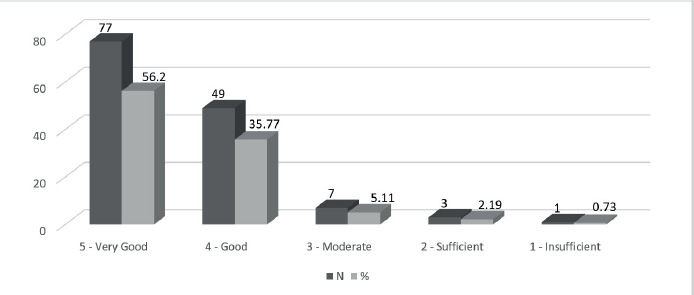
The majority of respondents said that the classes held at the MSC met their expectations very well (56.20%) and well (35.77%). Only one person stated that the classes did not sufficiently meet his/her expectations (Figure 1).
In the course of the study, an overall evaluation of medical simulation classes was carried out. For this purpose, 7 survey questions were used, with answers based on a 5-point Likert scale, where 5 points was the highest score and 1 point was the lowest score. The maximum a student could receive was 35 points, indicating the highest degree of satisfaction with the simulation activities. The lowest number of points was 7, reflecting dissatisfaction with the activities provided at the MSC. Based on the percentage distribution of responses, point ranges were developed to evaluate medical simulation classes, establishing the following grades: low, medium and high. The majority of respondents rated the specialist nursing simulation classes highly (56.52%) and medium (42.34%), with only two respondents (1.15%) at low (Table 1).
Table 1
Overall evaluation of the simulation classes at the MSC
| Score | Points | n | % |
|---|---|---|---|
| Low | 7.00-14.00 | 2 | 1.15 |
| Medium | 15.00-25.00 | 58 | 42.34 |
| High | 26.00-35.00 | 77 | 56.52 |
| Total | - | 137 | 100.00 |
The global determinant of the evaluation of the classes at the MSC, expressed in the arithmetic mean of the points obtained, was x̄ = 31.32 points and was in the high evaluation range.
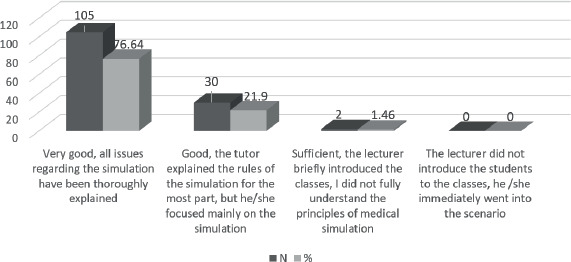
The next stage of the study analyzed the level of satisfaction with the different phases of the simulation. The survey results showed a very high evaluation of pre-briefing, as the vast majority of respondents (76.64%) marked the highest mark – very good. The second group, in terms of numbers, consisted of students rating the introduction to simulation as good, indicating that the instructor explained the principles of simulation (21.90%). None of those surveyed confirmed a lack of introduction to medical simulation (Figure 2).
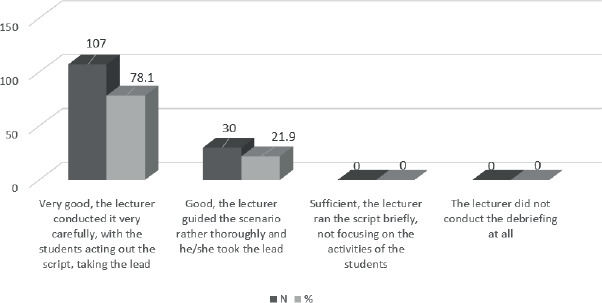
Nursing students’ evaluation of the de-briefing stage conducted after playing the scenario was also analyzed. Also in this case, the vast majority of respondents gave the highest ratings to the trainers: very good or good (78.10% vs. 21.90%), thus expressing their satisfaction with the discussion of the simulation (Figure 3).
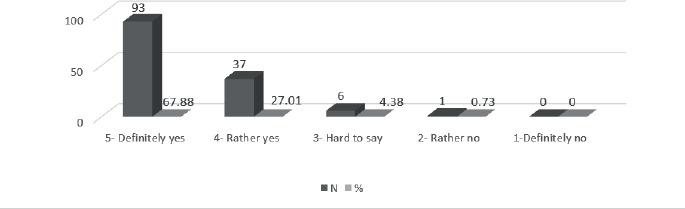
The majority of respondents were of the opinion that the competences acquired during the high-fidelity simulation would be very useful in their future work, marking a definite yes (67.88%) and a rather yes (27.01%) answer in the survey. Detailed data are included in Figure 4.
Figure 4
Score assessment of the competences acquired during the simulation in terms of their usefulness in future professional practice
The analysis of the research results showed a very high dependence of the assessment of simulation classes on the type of studies the respondents studied ((Chi-x2=34.364; df=2; p<0.0001). Students from the University of Economics, Law and Medical Sciences rated medical simulation classes at a high level much more often. Respondents from the Jan Kochanowski University in Kielce most often indicated an average level, as shown in Table 2.
Table 2
University at which the respondents’ study and their assessment of the MSC
Analysis of the results concerning the relationship between the evaluation of simulation activities and the year of study of the respondents, conducted with the Chi test2 revealed a statistically significant relationship (Chi-x2 =34.364; df=6; p<0.0001). Third-year students rated the simulation activities more favorably at a high level, while second-year students rated them at a medium level. Detailed results are presented in Table 3.
Table 3
The year of study of the respondents and the assessment of simulation classes conducted at the MSC
The study revealed a statistically significant relationship between the age of the students surveyed and the evaluation of medical simulation classes in specialist nursing (Chi-x2 =20.444; df=8; p<0.01). Students in the older age groups, i.e. over 25 years old, were more likely to rate medical simulation classes at a high level than students in the youngest age group of up to 25 years old, as shown in Table 4.
Table 4
The age of the respondents and their assessment of simulation classes conducted at the MSC
The next study analyzed the relationship between the global assessment of MSC classes and the respondents’ opinion regarding the usefulness of simulation classes in their future professional work. The results were statistically significant at level (Chi-x2=12.867; df=6; p<0.05). Respondents who assessed the level of classes at the MSC at a high and medium level believed that these classes were most useful in the context of their future professional work. They justified this by the reality of the scenario being implemented and the possibility of making independent decisions during the scenario implementation. They also pointed out the possibility of improving the level of knowledge within the scope of specialized nursing content. The detailed distribution of respondents’ opinions is included in Table 5.
Table 5
Opinion of the respondents on the usefulness of simulation classes in their future professional work and the global assessment of classes at the MSC
Discussion
Research shows that simulation is a valuable teaching and learning strategy, supporting the changing world of nursing education and helping to optimize learning [15-17]. Through simulation, students have many practical opportunities to repeat clinical scenarios and make immediate decisions and reflections [18]. Regular participation in simulated patient deterioration scenarios translates into earlier recognition and treatment of such emergencies in the hospital setting [19].
Simulation-based nursing teaching is one of the very important steps in health professions education. It is geared towards achieving educational goals through experiential learning using different types of simulation [20]. Simulation-based learning is a key pedagogical approach that has been implemented in curriculum design to help address some of these educational challenges. However, their implementation is highly variable, and research on evidence-based best practices in simulation design and implementation is fundamental to their success in the development of medical students [21].
Simulation technology is a practical tool in the education of nursing staff at all levels. Its educational effectiveness depends on students’ conscious participation and use of the knowledge provided, including providing feedback, engaging in deliberate practice, integrating simulation into the overall curriculum, and the instruction and competence of teaching staff in its application. Medical simulation complements, but does not replace, educational activities based on real patient care experiences [22].
In medical simulation, pre-briefing, also known as an information session in which the scenario is presented and instructions given, is essential [23]. In our own research, the vast majority of respondents (76.64% of respondents) highly assessed the pre-briefing, noting that the trainers explained all issues related to the simulation very well. In the study by Tomaszewska et al. mentioned above, students mostly stated that, as part of pre-briefing, they were familiarized with the simulation scenario (67.70% of respondents) and the capabilities of the simulator (58.1% of respondents) as well as informed about the available equipment (41.4% of respondents) and the layout of the rooms in the MSC (32.3% of respondents) [24].
At this stage of the simulation, de-briefing is important because participants learn about elements that were performed correctly and those that require improvement [25]. The vast majority of the students surveyed (78.10%) were satisfied with the de-briefing conducted, stating that it was very thorough and the students participating in it played a leading role. In the research conducted by Tomaszewska et al., students noted that it gives the opportunity to share experiences from the medical simulation (83.30% of responses), receive feedback from students regarding the simulation (48.90% of responses) or receive feedback from observers and presenters (45.70% of responses) [24].
As our own research showed, the majority of respondents (56.52%) rated the medical simulations carried out at a high level, assigning a score of 26 to 35 points. The global indicator represented by the arithmetic mean was x̄ = 31.32 points, while it should be noted that respondents rated the positive impact of the simulation on improving substantive knowledge and practical skills as the highest, as well as the fact that the acquired competences will be useful in their future professional work, obtaining for these determinants respectively: x̄ = 4.64 points and x̄ = 4.62 points out of a possible 5.0. In the above-mentioned research by Tomaszewska et al., according to 60% of respondents, medical simulations prepare them to learn practical skills, according to 36.80% they consolidate theoretical knowledge, and according to 14.20% they prepare them to broaden social competences. According to 41.90% of students, the skills acquired in the simulation center make it easier to work with patients in natural conditions, at the patient’s bedside [24]. A study by Guerero-Martinez et al. of 51 undergraduate nursing students from the Red Cross Nursing Center in Seville showed that they improve their knowledge and skills through medical simulations. The results showed statistically significant differences (p<0.0069) for global responses meaning large benefits of simulation for the dimension of satisfaction and perception of clinical experience, p<0.0001 for the dimension of satisfaction with simulation and obtaining an unsatisfactory grade x̄ = 4.51 [26].
The majority of students felt that the simulations prepared them for their future work. They motivated this mainly by the reality of the scenarios being played (54.74% of responses) as well as the possibility of taking independent actions (42.34% of responses). Similar views were presented in the study by Labrague et al. [27].
In our own research, the assessment of simulation classes was statistically significantly influenced by age (p<0.01), year of study (p<0.0001) and the university at which the respondents studied (p<0.0001). The global evaluation of the simulation, which oscillates around high, was more often given by students studying in the third year of nursing studies at the University of Economics, Law and Medical Sciences, representing the age group over 25, than by students of the same field at the Jan Kochanowski University in Kielce. This suggests that studying at a later age, often with the aim of changing one’s current job, provides a more mature view of the skills needed for a future, consciously chosen profession and an appreciation of the innovative nature of science such as simulations.
The final stage also explored how students perceive the benefits of MSC classes in terms of preparing them for their future work. In this respect, students who considered simulation activities to be useful in their work as a nurse were most likely to rate MSC activities highly (p<0.05). Students mostly justified this by the reality of the scenarios played out in class. Similar results were obtained in the study by Olaussen et al. [28].
The results of our own research correlate with the research of Kaldheim et al. where it was shown that well-designed/prepared simulation-based learning can develop self-efficacy in communication, interdisciplinary collaboration and task prioritization in critical situations [29].
To sum up, it can be said that most of the surveyed students rated the high-fidelity simulation classes highly, thus expressing their satisfaction with the classes.
Limitations of the research
It is important to mention some limitations of our research, which should be kept in mind when interpreting the results. Firstly, in this study, participants were recruited by their teachers. This may have influenced their decision to participate. Accordingly, participants were informed that their decision would have no negative consequences for them. This is a limited study, so the results cannot be generalized. However, they do broaden the understanding of how interprofessional simulation-based learning contributes to the development of self-efficacy. Secondly, due to the lack of a standardized survey instrument, a survey questionnaire of our own design was used. To address this limitation, future research should include a larger research sample while using more standardized tools.
Conclusions
Nursing students rated the high-fidelity simulation classes very highly, considering them very useful in their future professional work.
Respondents rated both pre-briefing and de-briefing very well.
The global evaluation of MSC classes was statistically significantly dependent on the type of university, the year of study and the age of the respondents.
Disclosures and acknowledgements
The authors declare no conflicts of interest with respect to the research, authorship, and/or publication of this article.
This research received no specific grant from any funding agency in the public, commercial, or not-for-profit sectors.
Prior to the start of the study, the students were informed of the purpose, assured of complete anonymity and voluntary participation. The study was conducted in accordance with the principles of the Declaration of Helsinki.
Artificial intelligence (AI) was not used in the creation of the manuscript.

